
Thinking & Drinking: Who Needs a Signature Grape?
Cabernet franc in Virginia, chenin blanc in California, ageworthy whites, skirt steaks, and drinking wine in Philadelphia.
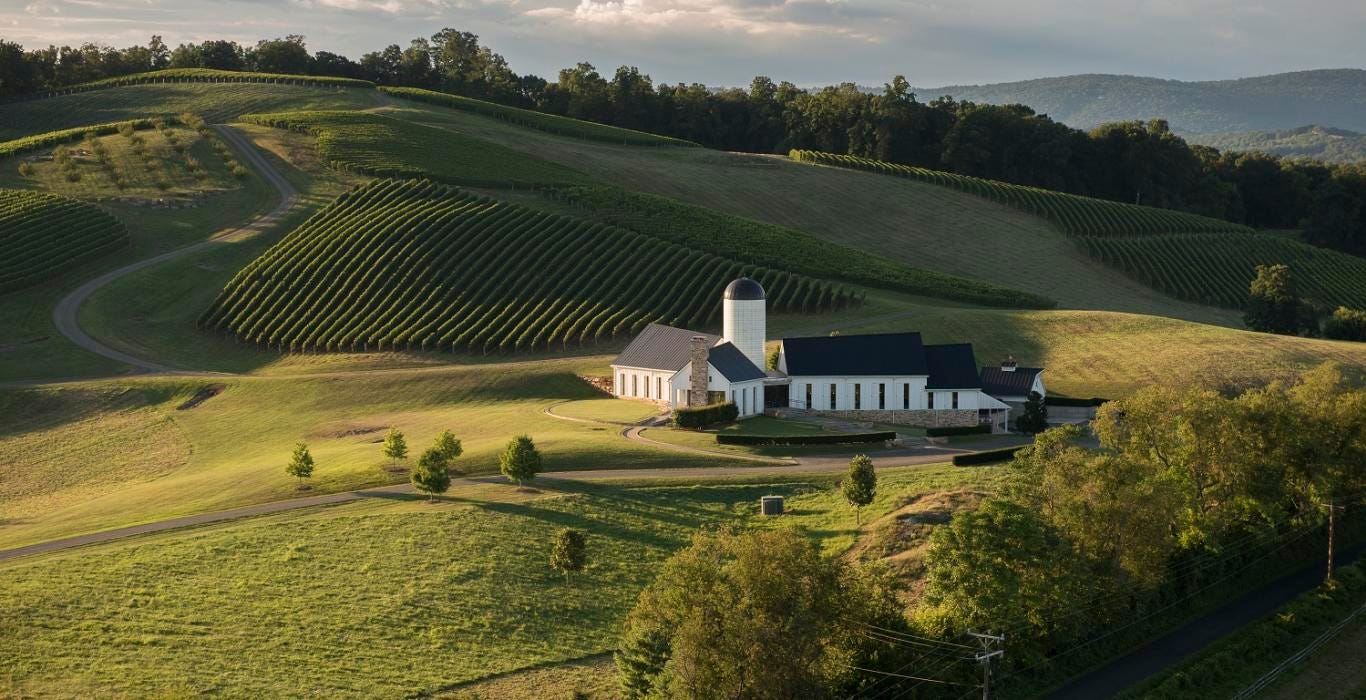
This week, I had the pleasure of speaking at the Virginia Wine Trade Intensive, a lovely event at the Jefferson Hotel in Richmond, Virginia. My panel, “Today’s Industry: Trends & Virginia’s Role,” was a wide-ranging conversation, with our moderator asking us about the trends reshaping wine consumption and what they mean for Virginia. The audience was clearly curious about how a region like Virginia might level up and elevate its presence in the world of wine.
I talked a bit about how the wine industry, everywhere, needs to unlearn certain myths and ways of thinking, to come to terms with funflation, to focus on connecting with the people who actually care about and buy fine wines, and to stop chasing people who either don’t care about wine at all, or only buy cheap branded bulk wine. There was the inevitable talk about creating “experiences” around wine. All topics, as readers know, that I’ve written about extensively in this newsletter.
Then the moderator asked me perhaps the diciest question in American wine: “Do you think Virginia needs to have a signature grape?” Both the audience and the panelists had been dancing around this issue. It’s a touchy issue in Virginia. Back in 2011, viognier (yes, viognier!) had been designated the state's signature white grape. Fifteen years later, many people in Virginia see the viognier-as-signature-grape move as having been a mistake.

When the moderator asked, “Do you think Virginia needs to have a signature grape?” I looked out into the audience and could see plenty of people vigorously shaking their head “no.” During the panel, there had already been some boosterish talk about Virginia’s “diversity of grapes”—from chardonnay to merlot to cabernet sauvignon to cabernet franc to petit verdot to petit manseng.
But I said what I said: Yes, after decades of experimenting with dozens of varieties, Virginia absolutely needs to choose two or three signature grapes and focus on those. I suggested that cabernet franc as a red and petit manseng as a white both seemed to have a lot of potential in Virginia’s terroir. There was pushback.
In U.S. winemaking, it always surprises me what an unpopular opinion it is to suggest that a region focus on a signature grape that works well in the terroir. This concept seems old hat in Europe. You don’t just open a winery in the Loire Valley and start growing furmint, grüner veltliner, rkatsiteli, or whatever the hell else you want to grow. There’s a reason winemakers grow and focus on chenin blanc and cabernet franc in Touraine and Anjou, sauvignon blanc and pinot noir in Sancerre, and melon de bourgogne for Muscadet along the western Loire near the coast. Meanwhile, in the U.S., no one would be surprised to find chenin blanc, sauvignon blanc, pinot noir, and melon de bourgogne—plus furmint, grüner veltliner, and rkatsiteli—grown in the same vineyard, somewhere in New Jersey or Idaho or Michigan.


I mean, I get it: we’re ’Muricans and we don’t like being told what we can and cannot do. Also, the AVA (American Viticultural Area) system simply does not carry the same qualitative weight as European AOCs, DOCs, and DOs.
For years, I’ve covered the Finger Lakes—where it is very clear that riesling and cabernet franc should be the white and red grapes of focus. But show up at any Finger Lakes winery and there’s a pretty good chance you’ll find a crazy array of grapes: pinot noir, syrah, chardonnay, pinot grigio, grüner veltliner, blaufränkisch (called lemberger in FLX), or even hybrids like catawba, concord, and delaware. As a critic, I visited wineries that poured me over thirty expressions from one vintage. Focus, people, focus!

Beyond the obvious reason that certain grapes just grow better in certain soils and microclimates, there is a human creative element to constraints. Constraints are a creative virtue; they force innovation. Growing any old grape where it may or may not belong is, as Robert Frost famously said about free-verse poetry, “like playing tennis with the net down.”
This is not to say that one shouldn’t experiment with new grapes. (And those of us who like free-verse poetry may disagree with Mr. Frost). Certainly, with any up-and-coming wine regions, there’s always an ongoing, and healthy, debate over which grapes actually grow best and should be the signature grape. But at some point, a movement of winemakers will coalesce around particular grape variety and lead the charge.
In Virginia, that seems to be happening right now with cabernet franc and petit manseng. Cabernet franc is swiftly becoming the key red grape throughout northeastern U.S. and so that’s not a surprise. On the other hand, petit manseng, the white grape of Jurançon in Southwest France, is a bit more unique.

I tasted terrific cabernet franc from wineries such as Paradise Springs, Veritas, Early Mountain Vineyards, and Cross Keys Vineyards. As for petit manseng, I tasted interesting ones from both Paradise Springs and Veritas, as well as from The Winery at La Grange. I also tasted a super interesting white blend from Veritas, with petit manseng along with chardonnay, viognier, and sauvignon blanc.
However (going against my own argument here) one of the favorite wines I tasted was Barboursville Vineyards’ 2024 Vermentino Reserve. So, who knows, maybe vermentino could be Virginia’s signature grape?
What I’ve Been Drinking, Part 1: Ageworthy Whites
Many believe the future of wine is white. White wine recently surpassed reds in worldwide consumption. In the U.S., white wine consumption has risen nearly 75 percent over the past two decades. So why aren’t more people collecting and cellaring top white wines? White Burgundy isn’t getting any cheaper and where else should you be looking?

In that latest edition of my Beyond Everyday Drinking Wine Club, I’ve got a few answers for you. This quarter, it's all about premium white wines, and I've picked three top, ageworthy whites for you, from Rioja, from Mountlouis in the Loire Valley, and from Germany's Rheinhessen. I’ve also got a surprise rosé in the box that will become your favorite summer pink wine.
Anyone who signs up for my wine club this month will receive the current box, plus my partners at SocialSomm will send you a free bottle of wine as a special gift.
If you’d prefer to just buy one of the three wines I’ve selected, just scroll down.
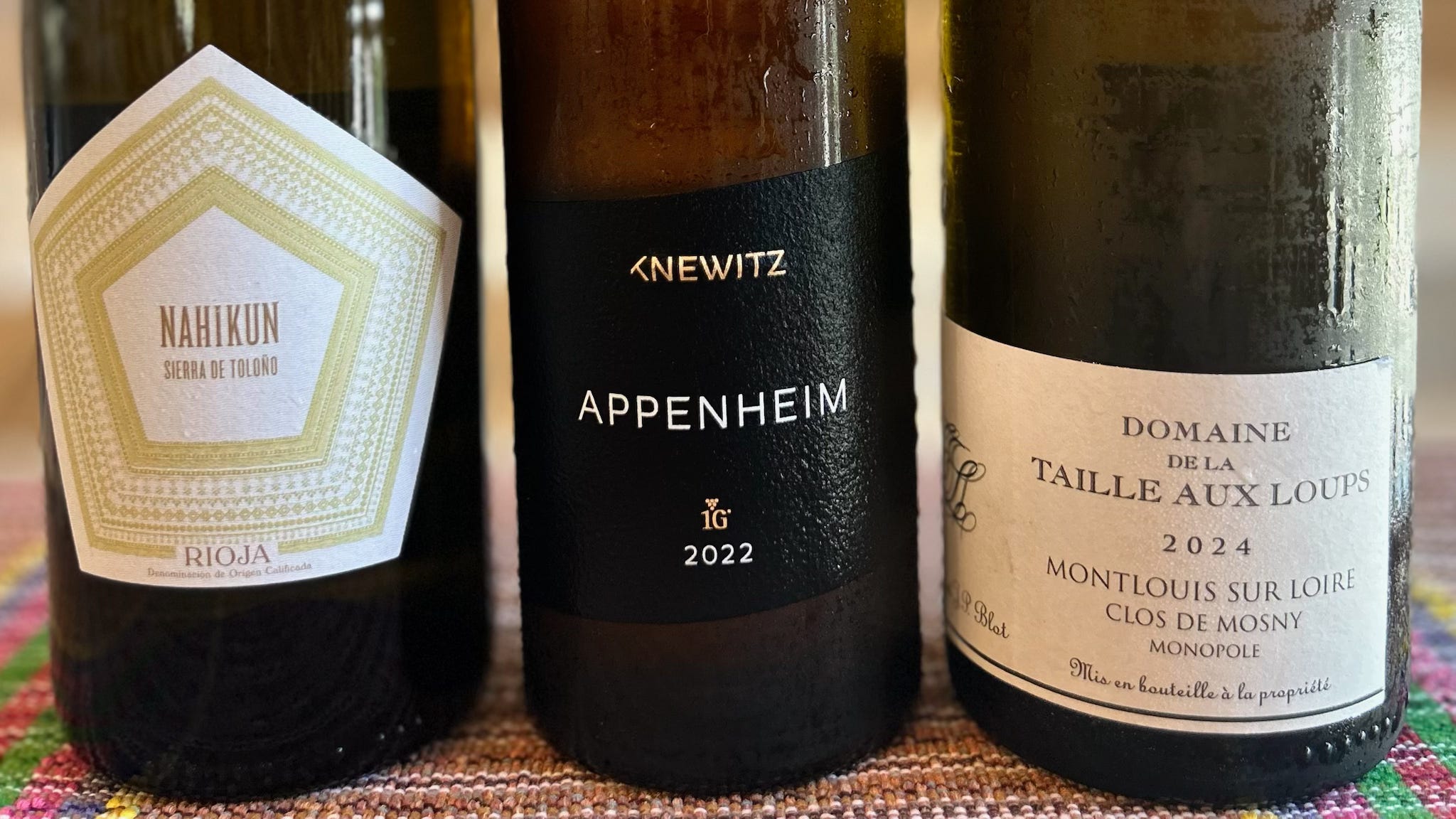
Knewitz ‘Appenheim’ Riesling Trocken 2022 ($33)
Knewitz is among the best up-and-coming wineries in Germany, and this bone-dry riesling, with thrilling acidity, profound minerality, and intense power is a great introduction to the new wave of German wine. Brothers Bjorn and Tobias, along with Tobias' wife Corina, make honest, terroir-driven wine in Rheinhessen, and this 2022 shows just how ageworthy good riesling can be.
Domaine de la Taille aux Loups 'Clos de Mosny' 2024 ($46)
Jacky Blot was one of France’s legendary winemakers, known for putting the Loire appellation of Montlouis on the map with his bone-dry chenin blanc at Domaine de la Taille aux Loups. His son Jean-Philippe now carries on the family legacy after Jacky’s death in 2023. This complex white represents everything you should love about chenin blanc, with a balance of fruit and minerality, thrilling tension, crisp acidity, and great texture.
Sierra de Toloño ‘Nahikun’ Blanco 2025 ($47)
This stylish, elegant white comes from high-altitude, 80-year-old vines of viura and malvasia. Winemaker Sandra Bravo is among Rioja’s excellent new wave, and this shows why the region, known for its reds, is also a world-class place for ageworthy white wine.
What I’ve Been Drinking, Part 2: California Chenin Blanc
I have an article on California’s chenin blanc revival in Wine Enthusiast’s current California issue. The article is only in print, so you’ll have to find a copy. But here’s a snippet:
It’s early impossible to talk about California white wine without focusing on Chardonnay. But there was a time before Chardonnay overshadowed every other white variety. In the 1970s and ’80s, surprising as it may seem now, Chenin Blanc was among California’s most popular grapes. In 1985, Chenin Blanc accounted for 25% of all white-wine grapes crushed in thestate, second only to Colombard.
Consequently, there are a lot of older chenin vineyards in California, dating to the 1970s and 1980s, that grow amazing chenin blanc. With wineries like Haarmeyer Wine Cellars, Sandlands Vineyards, Pax Wines, Hammerling Wines, Broc Cellars, and The End of Nowhere leading the way, chenin blanc has a bright future. In May, the latest edition of Hella Chenin, a super fun, chenin-based festival went off to a roaring success. Is California chenin blanc about to have its moment?
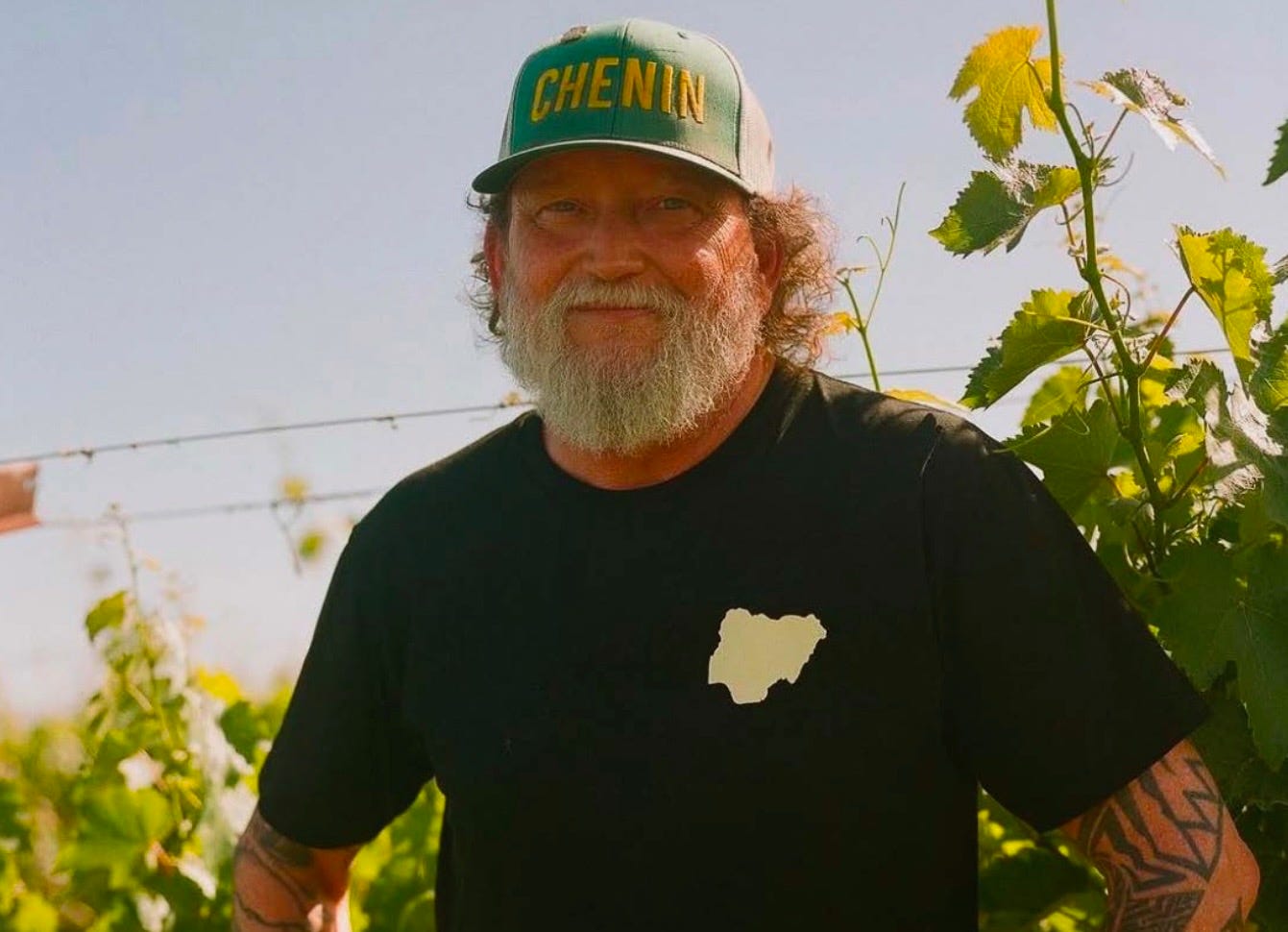
“I’ve been waving the Chenin flag for 15 goddamn years,” said Craig Haarmeyer, the West Sacramento–based producer whose organic, low-intervention Chenin Blancs grown in Clarksburg have become some of the most sought-after in California….“It’s acid-driven, food-friendly, and complex. It’s a three-dimensional wine…It’s Chardonnay without training wheels.”
Haarmeyer freely admits that California chenin blanc will always be different from that found in the Loire Valley, chenin’s homeland. “It’s damn near impossible to pick Chenin underripe here,” he told me. “I’m not trying to make French wines. I love Savennières, but we’re never going to make Loire Chenin here.” That’s totally okay! Perhaps it more closely mirrors the best chenin blanc coming from South Africa. Or perhaps California chenin is its own wonderful thing entirely.
Four Fine California Chenin Blanc


Haarmeyer Wine Cellars ‘St. Rey - SRV’ Chenin Blanc 2024 ($20)
Among California’s very best chenin blanc, from Sutter Ranch Vineyard in Clarksburg. Dry, austere, and mineral, yet also ripe, vibrant, and fruity. If you want to try “alt California” here’s a good place to start.
RZN Wines ‘The Lightning Issue” Chenin Blanc 2023 ($30)
I tried this bottle from a new-to-me Santa Barbara winery (pronounced “Reason Wines”) the other day and loved it. From Tres Hermanas Vineyard on the Central Coast. Fresh, zippy, pithy, chalky, with tangerine, white grapefruit, and honeysuckle.
Broc Cellars ‘Happi Chenin’ 2023 ($34)
Berkeley-based Broc Cellars is one of my favorite California wineries. Their gorgeous chenin blanc from Massa Vineyard in Carmel Valley, grown at 1,500 feet. Peach skin, grapefruit, fresh herb, ripe but precise, pithy and silky. Hard to find.
The End of Nowhere ‘Little Faith’ 2025 ($22)
Love this producer in quaint Amador City (great tasting room, you should visit). This skin-contact bottling is a blend of 40% chenin blanc, 30% chardonnay, and 30% pinot gris. “Chenin brings the leaness, chardonnay the roundness, and pinot gris brings the aromatics,” says winemaker Chris Walsh.
Where I’ve Been Drinking: Philadelphia


This is going to be an exciting summer in my home city of Philadelphia: We’re hosting the FIFA World Cup and the MLB all-star game, as well as plenty of festivities around the 250th anniversary (aka Semiquincentennial) of the United States. (Note: for my European readers, and for younger people who used AI in history class, Philadelphia was the first capital of the U.S. and is where the Declaration of Independence was signed).
Given all the exciting things happening in Philadelphia, I figured I would share a few of my favorite places for wine in the city.
Manong
I’m loving this newish Filipino wine bar/all-day café/restaurant that opened in my neighborhood at the end of 2025. It’s a super spot to sit at the bar and eat lumpia, tagalog skewers, pork adobo, or swordfish along with great wine list and cocktails. Manong also has a nicely curated wine shop of organic, low-intervention bottles.
Wine Dive
Another fun spot, in Center City near Rittenhouse Square, that opened in late 2025. Wine Dive describes itself as “Where Old Hollywood meets Atlantic City,” dark with red accents, and it’s definitely a vibe. There’s a good selection of 20 wines by the glass, but my favorite feature is the fresh chicken cutlets served from behind the bar ($10).
Superfolie
Probably my favorite wine bar in the Center City right now, with super food and always one of the best wine selections in the city (and also a great take on the Spanish tinto de verano). Also check out their sister location, Superétte, in East Passyunk.
Jet Wine Bar
Jet Wine Bar has been around for a while, a staple on 15th and South. But they’ve recently opened their outdoor wine garden, which is a great. Owned by Jill Weber, a professional archaeologist who loves obscure wines, it’s always been a place to find Georgian, eastern European, and other lesser-known wines.
Fountain Porter
This cool neighborhood spot in East Passyunk is not technically a wine bar—in fact, you could also call it a craft beer bar. But there’s always a great rotating selection of interesting low-intervention wines on the chalkboard. The only food on the chalkboard is burgers ($6), pickles ($5), and fries ($4).
Sally
Pizzeria Beddia always grabs the headlines for pizza and natural wine. But I’ve always liked this Fitler Square spot (which also was awarded a Michelin Bib Gourmand in 2025) much more, without the crowds and hype. Besides great pizza and pasta, Sally has a nicely curated natural wine shop.
What I’ve Been Eating While Drinking: Skirt Steak
One of food media’s most cherished tropes is “grilling season.”
This is, presumably, the season when the weather starts to warm, and readers liberate their grills from the depths of cold winter storage to fire them up en masse. We start seeing these articles in April, though sometimes a bit earlier, depending on when the news gap after Easter and Passover falls. It usually begins with annual grill reviews and tips on, say, best barbecue sauces, then moves on to recipes for “unusual” things to grill (Have you ever grilled a vegetable!? Or a peach!? Maybe you should!). By Memorial Day, there’s a full slate of stories about how to clean your grill and a shoutout to plant-based grilling options, and by the lead-up to July Fourth, we get features about safety, on the dangers of cooking with fire, and of undercooked meat.
At some point during this season, we’ll get the annual articles on what wines to pair with the food you grill. This is where we generally hear about how well barbecue pairs with California zinfandel, or matching Argentine malbec with steak.
For many of us who love grilling, the whole idea of “grilling season” feels a little imaginary. It presumes a readership consisting only of those in northern climes where winter temperatures hypothetically discourage grilling. Moreover, committed grillers do not pay too much attention to the weather. I’ll grill in a snowstorm if the spirit moves me. I take both grilling and wine seriously regardless of the season.
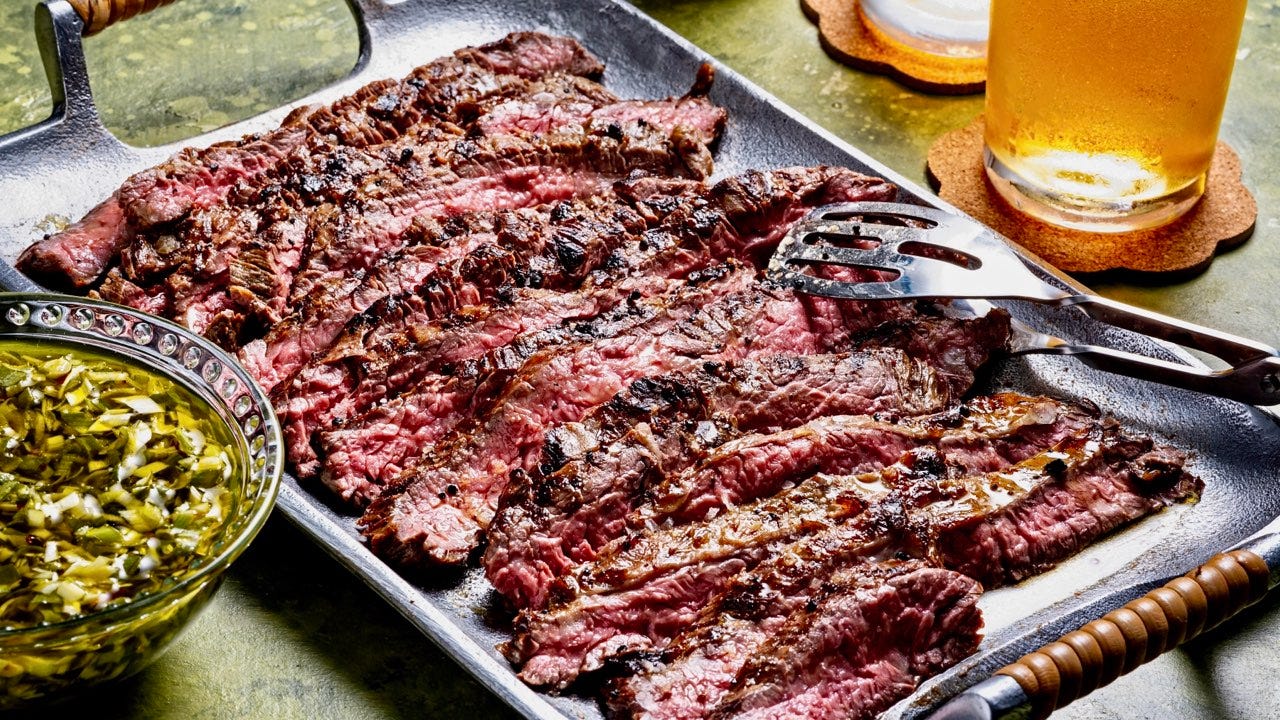
I like grilling pork, fish, burgers, whatever. But my absolute favorite cut of beef is skirt steak. It’s simple and delicious.
I usually prepare it one of two ways. First, would be with simple marinade—soy sauce, toasted sesame oil, grated garlic and ginger, salt and pepper—several hours before grilling. Or, if I’m being super lazy, I’ll do a cheater “carne asada” style, by rubbing the skirt steak with olive oil and the Whole Foods “Peruvian Style Seasoning” (“Citrusy & Robust” according to the label). In either case, the grilling part is simple, about three minutes each side on super-hot direct heat. Let it rest for a few minutes, and then slice into thin strips. A grilling season delight!
What to pair with it? Keep reading.
Seven Skirt Steak Wine Picks
Felix R&B NV ($15)
An exciting new collab from importer Winemonger and Stefan Wellanschitz of Kolfok from Burgenland, Austria. This is a blend of blaufränkisch and rotburger (they chose to use the local name of zweigelt to avoid its complicated and controversial associations). But there’s nothing complicated or controversial about this juicy, crunchy, fresh, and delightful wine with a great balance of savory herb, red fruit, and peppery notes. A wonderfully affordable spring red.
Olga Raffault ‘La Fraich’ 2024 ($20)
Entry level wine from this benchmark Chinon winemaker. From young vines, organic, and aged only for six months in stainless steel. It’s a classic vin de soif with great juicy acidity, fresh fruit, and earthy notes.
Celler Pardas ‘Sus Scrofa’ 2023 ($23)
I’ve fallen in love with sumoll, the Catalan grape that makes bright, fresh, savory reds. “Nobody loved sumoll until recently,” says winemaker Ramon Parera. "It’s a crazy grape.” Sus Scrofa is a red for contemporary tastes. Electric and lively, almost like a young nebbiolo with earthiness, dark minerality, juicy red fruit, cherry tomato edgy tannins and a cool, stony finish.
Sierra de Toloño Rosado 2025 ($24)
Everyone needs a house pink wine for summer sipping, and this rosé from Rioja is mine for the season. Sandra Bravo's rosado from tempranillo and garnacha is serious and complex, darker in color than the typical pale pink. But it doesn't forget what rosé is supposed to be: fun, fruity, delicious, and refreshing.
Château La Colombière Fronton 2024 ($30)
Négrette is a lesser-known grape from Southwest France, particularly from the AOC Fronton, near Toulouse. This blend of 90% négrette and 10% syrah is a good introduction to the grape, which makes juicy, drinkable wines, balanced by savory notes. This is a perfect chilled red.
Domaine de la Noblaie 'Les Chiens-Chiens' 2022 ($33)
Chinon, in France's Loire Valley, is a spiritual home of Cabernet Franc. Jérôme Billard of Domaine de la Noblaie is among my favorite Chinon winemakers. This bottle comes from 30-year-old vines from a vineyard that literally means “Dogs-Dogs.” Textured, serious, dark, and chewy with dried herb, plum, black olive, blistered tomato, and even a hint of espresso. Super complex. An example of oak aging in Chinon (12 months in large neutral oak) that’s understated.
Christian Tschida 'Kapitel I' Cabernet Franc ($54)
Cabernet franc from Austria? Yes, it exists! You can find it in Burgenland, around Lake Neusiedl, where Christian Tschida works wonders with this variety - adding a bit of local blaufränkisch to the blend. Anyone who's followed my work knows how much I admire Tschida's wines, and this is one of my favorites. This wine has finesse, texture, and elegance, with spice, pepper, red berry and a great long finish.
A signature grape for each region? A noble concept, indeed.
Here's the challenge for Arizona: our weather is BONKERS. A wet winter followed by a dry-as-a-dead-bone summer. Next year? A dry-as-a-dead-bone winter followed by monsoon floods in the summer.
High winds during pollination. Frosts in late March nip new buds. Frosts in early October kill fledgling growth as it prepares to nap for the winter.
The list goes on.
No single grape could be successful in this climate.
Hmmm...you might be asking. Why on earth would anyone grow grapes in Arizona?
Simple. We celebrate the successful varietals, albeit different ones each year, and make stunningly delicious blends with the rest. At last count, I found growers here in Arizona have planted more than 100 varietals -- everything from Cabernet Sauvignon to Vranac. You really should stop by and give us a try.