'Drops of God' Asks a Great Question: Are Wine People Good People?
The show about wine connoisseurship inadvertently leads to a really big idea: What is the point of all this anyway?
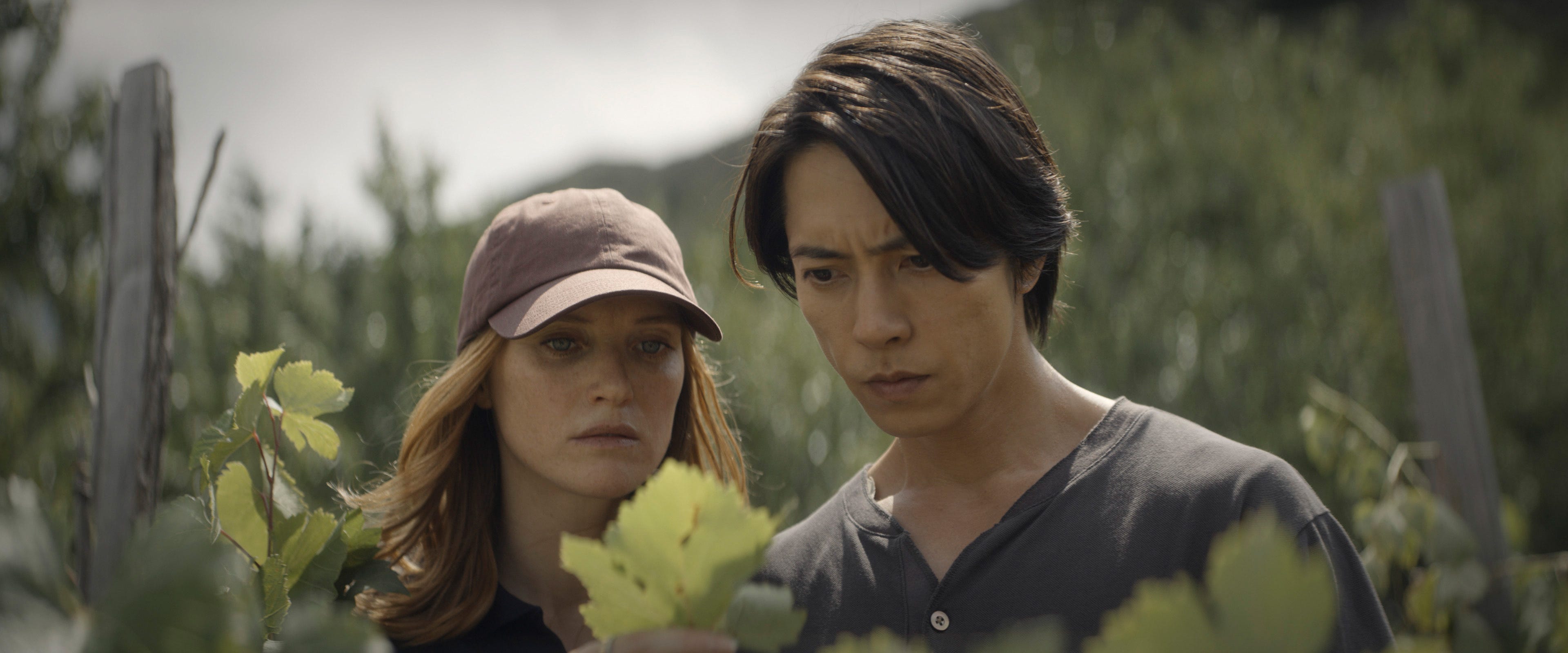
“Maybe you wine people have a point after all,” says Davit, the rich Georgian businessman, the villain in season two of Drops of God, the popular wine drama on Apple TV. Davit is drinking Château d'Yquem along with Camille and Issei, the internationally famous wine experts who share the same father, whose twisted inheritance tasting competition pitted the two as rivals in season one. As skeptical as Davit is, in this scene he’s got to admit the legendary noble-rot wine tastes pretty damn delicious.
Davit is the villain because he intends (due to some complex family bad blood) to rip out the vineyards of his sister Tamar (whose wine from the rare hybrid herbemont grape is the most exquisite nectar in the world, says everyone who takes a single, near-orgasmic sip) and to build a golf course. Camille and Issei (who by now have made up as brother and sister) are trying to buy the property to save the vines. Davit, with questionable intentions, invites them to a soirée at his mansion where he’s asked the two to dazzle a potential business partner who happens to be a wine snob.
“I’m thinking maybe you could come over tonight,” Davit says. “I don’t know, impress her with wine…sisulele”
“Sisulele?” asks Camille.
“Bullshit,” says Davit.
Villain or not, Davit likely speaks for the many non-wine people who presumably are watching Drops of God. Since the first episode dropped in late January, many of these non-wine people—namely my friends and family—have been asking me what I think about Drops of God.
Well, frankly, Drops of God is a mostly spot-on depiction of the wine world. Uncomfortably so, to be honest. Or at least, what it gets right far outweighs what it gets wrong. Yes, yes, there are certain details that we can nitpick as slightly off, and the show occasionally leans too heavily on certain ideas and themes for dramatic effect (the specialness of pinot noir is talked about too often, for instance). And sure, Camille and Issei at times speak about wine as if they are mystic yoga instructors, and at other times like they’re high school teachers gassing up a class of gifted-and-talented students. But in broad strokes, Drops of God gets at the essence of the wine world’s various pressures, its petty rivalries, its ethical dilemmas, its gatekeeping, its pay-to-play, and how all of that is so often driven by individuals’ insecurities.
The inciting quest of Drops of God season two happens at Camille and Issei’s birthday dinner, when they are presented a mystery wine with no label, along with a letter from their dead father, the famous wine critic Alexandre Léger, a sort of Robert Parker-esque figure whose guides are the lodestar of the wine industry.
Despite his influence in the world of wine, it’s already well established in season one what a terrible father Alexandre was to Camille and Issei (who was his mistress’ child). It’s repeated over and over that Alexandre’s only true love is wine. His terribleness persists after death with his cruel challenges from the grave.
Despite this, their father’s post-mortem challenge to identify the mystery wine (which he claims is the greatest wine he ever tasted) sends the two on a quest to Spain, to Greece, to the grapevine archive at the Domaine de Vassal experimental vineyard in Montpelier, France, and ultimately to the Republic of Georgia—where they get themselves much too deeply involved in the drama of the family who makes the mystery wine.
Drops of God is a fascinating show in that its two main characters, Camille and Issei, are not particularly likeable. In Issei’s case, we can see his deadpan, detached, possibly-on-the-spectrum demeanor as a trauma response. But Camille (though also traumatized) is as an objectively bad person, much like her father. In season two, she’s basically an anti-hero, which is certainly a staple of quality television. But here’s the thing: the public already has a negative view of the shady worlds and industries that Tony Soprano (the mob) or Walter White (meth dealing) or Don Draper (advertising) inhabit. The idea of an anti-hero in wine should be fairly unsettling to those of us who inhabit this world.
Camille and Issei’s quest to find the mystery wine quickly becomes a crusade to save the wine from being destroyed by the villainous Davit. But Camille’s plot to save it is hatched from the worst aspects of wine culture: Namely, attempting to artificially create a coveted demand for a unicorn wine by cutting deals and cheating at a tasting competition. This is when things go off the rails. In her campaign to save the obscure Georgian wine, Camille ends up trashing her reputation, the credibility of her wine guides, her ownership of her winery, and—most of all—her relationship. For what exactly?
Even Issei becomes skeptical of her efforts. “We got involved in a story that’s not ours,” he says. “The wine is beautiful, and it’s going to be lost.”
Camille won’t hear it. “Come on,” she implores. “We saved the wine.”
But is that enough? Is it enough to justify the chaos that Camille causes all the people around her? Even the winemaker who makes this mystical wine, in the end, doesn’t want it saved. Without spoiling too much, even bigger tragedies abound.
“You’re selfish just like your father,” Issei tells her.
“You’re bored to death as soon as you have to stay in the same place for three minutes,” Camille’s fiance Thomas tells her. “You don’t even think about the impact it might have on other people.”
As someone who’s doggedly gone after my own quests for obscure wines and lost causes, often to the detriment of my own loved ones, I have to take a step back from my own viewing of Drops of God, and self-reflect. Not gonna lie, it hits uncomfortably close to home.
The tragic flaw of the characters in this show is that they care about wine too much. And this is what Drops of God gets absolutely right. High-level wine culture attracts obsessive, hyper-sensitive, emotionally stunted people. The characters in this show—like many of us—give wine this power over their lives. Maybe it’s because we don’t know where to put our emotional weight. Or maybe it’s something else. In any case, it eventually starts to feel more important than it is. Or at least that’s how it comes across to people who are not in our world.
This comes across in scenes where wine people are dealing with those who are not wine people. At one point, the unreliable Camille is teaching Davit about how to taste wine, and tells him, “Wine is like music. It connects you to your emotions. It repairs wounds.” He remains deeply skeptical—as he should be—about all this sisulele.
In a scene near the end, over some cheap rosé at the beach, Natasha, the diving instructor and Issei’s love interest, sums up what might be the outsider’s view of all this: “So, you basically betrayed your friends…and your father-in-law…and the love of your life?” What’s left unsaid, in her quiet judgement, is this: Over wine?
Yes, over wine.


I remember having a similar series of conversations about DC and the political scene in the wake of the House of Cards premiere in 2013. The show was far more Machiavellian than the bumbling Jeds ambling through the corridors of power in the nation's capital. Veep, on the other hand, hit the nail on the head. Maybe this means there's space for wine black comedy that fully satirizes this world as well. I've seen some sketches on TikTok and IG that serve as great send-ups, but a good Veep-style Armando Ianucci vehicle that plays up the wine world's absurdities would absolutely find a loyal viewer right here.