"Wine Should Be a Mirror of a Place, Not a Mirror of Our Mistakes"
Sicily's Arianna Occhipinti, then and now.
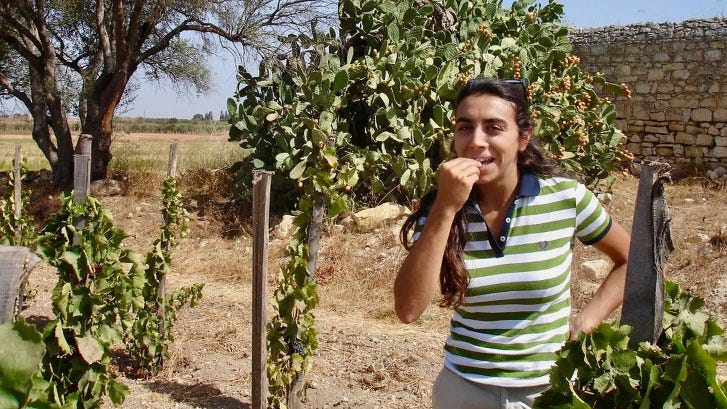
Today, I’m thrilled to publish this profile of Arianna Occhipinti (one of Everyday Drinking’s favorite winemakers) by Robert Camuto, whose wine and travel writing I’ve long admired. For me, Robert’s 2010 book Palmento: A Sicilian Wine Odyssey was a model of what wine writing could be as I began writing seriously about wine. After many years writing for Wine Spectator, Robert is now publishing a newsletter on Substack, Italy Matters, which you should definitely check out.
The first time I drove through the Sicilian countryside to meet Arianna Occhipinti was in the summer of 2008, when she was on the verge of becoming a phenom—a 25-year old who’d returned home from enology school to make wine from a 2.5-acre vineyard.
Vittoria, Sicily was no country for young men. Let alone young women.
Yet here she was in her fifth vintage. She was a symbol that grew with time—a smart and attractive Sicilian with a great mane of thick black hair—who chose to stick around and not escape with much of her generation to Milan or London or New York. What’s more, she was an Italian woman speaking about wine not in a cocktail dress but in work boots dusted with soil.
She was also a living poster for “natural wines,” with her infectiously simplistic view of winemaking.
“You squeeze the fruit, let it ferment, and basta,” she told me.
But she was too smart and driven to settle for “the-wine-makes-itself” schtick, and to bottle stuff that wreaked of volatile acidity and brettanomyces while tiptoeing towards vinegar.
That year she would produce her first red vintage of the wine that kicked her business into hight gear. SP 68 – named for the main two-lane road that cuts through Ragusa province on the southeast of the island-- was a traditional Vittoria blend of light zingy frappato and darker, brooding nero d ‘avola.
Fermented in stainless steel and released amid the 2009 financial crisis at $25, the wine hit a bullseye for drinkability and affordability. (The New York Times’ Eric Asimov, called it “fresh, juicy, and joyous”). Stocks quickly sold out.


When I visited Arianna five years later, I was stunned by the signs of her success. She was rushing to complete an enormous new winery on a 60-acre farm of vineyards, citrus and olive groves, wheat fields and a majestic 19th-century baglio (Sicilian farmhouse) in Contrada Bomboleri.
She was a producer of 120,000 bottles a year—wines that were becoming fresher and cleaner tasting and shedding their “must-be-organic” naïve mantle. Though she wouldn’t say it, she’d left most of the natural wine world in the dust.
And she made the smartest statement I’ve ever heard from a young winemaker.
“Wine should be a mirror of a place-- not a mirror of our mistakes,” she said.
In other words, Arianna was on a quest to make great wine and to show the world her corner of Sicily.
“My idea was always the same-- to express this territory,” she went on, her hand chopping the air in front of her. “I will finish my life with the same idea.”
Organics, biodynamics, fermenting on indigenous yeasts, no filtering, scant use of sulfites, gentle and simple winemaking and all the rest, were never an end, but a way to put more distinctive sense of “there” in the glass.
Last week I visited Arianna again, this time as part of a group of somms and Italian journalists to talk about wine and the world, to eat and drink, and discuss her latest obsession.
Arianna’s first wine obsession was, of course, frappato. Her wines broke the mold of the Sicilian heartland as a producer of wines that resembled sun-parched leather. She coaxed out freshness and saltiness with a ruby-colored liquid that almost seemed lighter than its weight in the glass.
At 43, with the first small lines of exprerience gathering around her dark intense eyes, Arianna now makes four versions of frappato—a wine that in her youth was viewed as “an entry level pizza wine.”
All four are fermented in aged in cement takes without barrels. There is her flagship “Il Frappato” and three single vineyard crus called PT, FL and BB, planted on variations of the local soils: white sands and red sands, compact limestone and porous calcareeous tufa
In recent years, with demand for her wines outstripping supply, Arianna has turned her gaze to grillo, one of Sicily’s most planted white grapes chiefly on the western side of the island near her birthplace of Marsala.
Grillo, a late-19th-century cross of Sicily’s Catarratto and Zibibbo (Muscat of Alexandria) was bred to be blended for aged and fortified Marsala wines. In recent decades it has been vinified alone as a dry table wine—with results that vary from vinous fruit punch to exquisite.
Arianna was inspired in Marsala by the dry, salty grillo wines of Marco de Bartoli’s son Renato and decided to try her hand at it in Vittoria, where the grape is known as riddu.
“Grillo is a grape of the sea,” she says. “It has a great potential to absorb the flavors of sea stones. It actually has a lot in common with chardonnay.”
To make her Grillo wines, Arianna has focused on two vineyards where limestone dominates, planting them both with massal cuttings from De Bartoli vineyards.


The first was in the Chiaramonte di Gulfi, Called Santa Margherita—a high altitiude clay and limestone vineyard about a halfhour drive from her winery. The wine called SM was first vinified in 2020, showing power and body under its elegant surface.
The second wine, launched with the 2025 vintage and set for release this spring, is called Serracalcara, from her the redder sands and calcareous pebbles of her Bombolieri farm. It’s a blade-sharp version that begs for a plate of delicate raw gamberi rossi (Mediterranean red prawns) fresh off the Sicilian fishing boats that dock about five miles from her winery.
The wines are delicious. But, as always with Arianna, the variety is not the end—it’s a vehicle to show off the vineyards.
On the second day of her gathering we tromped through wet and muddy vines blanketed with chest high wildflowers and cover crops. We tasted and tasted some more, and toured her cellars—Arianna the whole time gesticulating, chattering a mile a minute. Geology. Soils. Technical details of the wines. Southern Sicily that sits at a latitude south of Tunis, Tunisia.
We spoke about the wine crisis, the human crisis, wine “storytelling”, and ethics, while one of her staff put color- coded Post-it notes on a whiteboard.
Arianna has a total of 30 employees—twenty of whom work in the vineyards. Her team is young and energetic. They drink together, cook together and seem to enjoy hanging out.
She is her own enologist and doesn’t use a consulting winemaker. Rather she uses the services of a consulting psychologist for group and one-on-one motivation.
At first she says her grizzled vineyard workers were suspicious. Had anybody ever asked how they felt?
“He helps people work at their potential,” Arianna says. Then, as if it were necessary to explain, she says, “I make people work at maximum speed.”
Out the front gate of her farm runs SP 68, which connects her world and in Sicilian wine has come to be known as the fast lane.


